Why Real-Time Payroll Needs 'CaseMan'
1 October 2026 · Christian Kobler · 4 min read
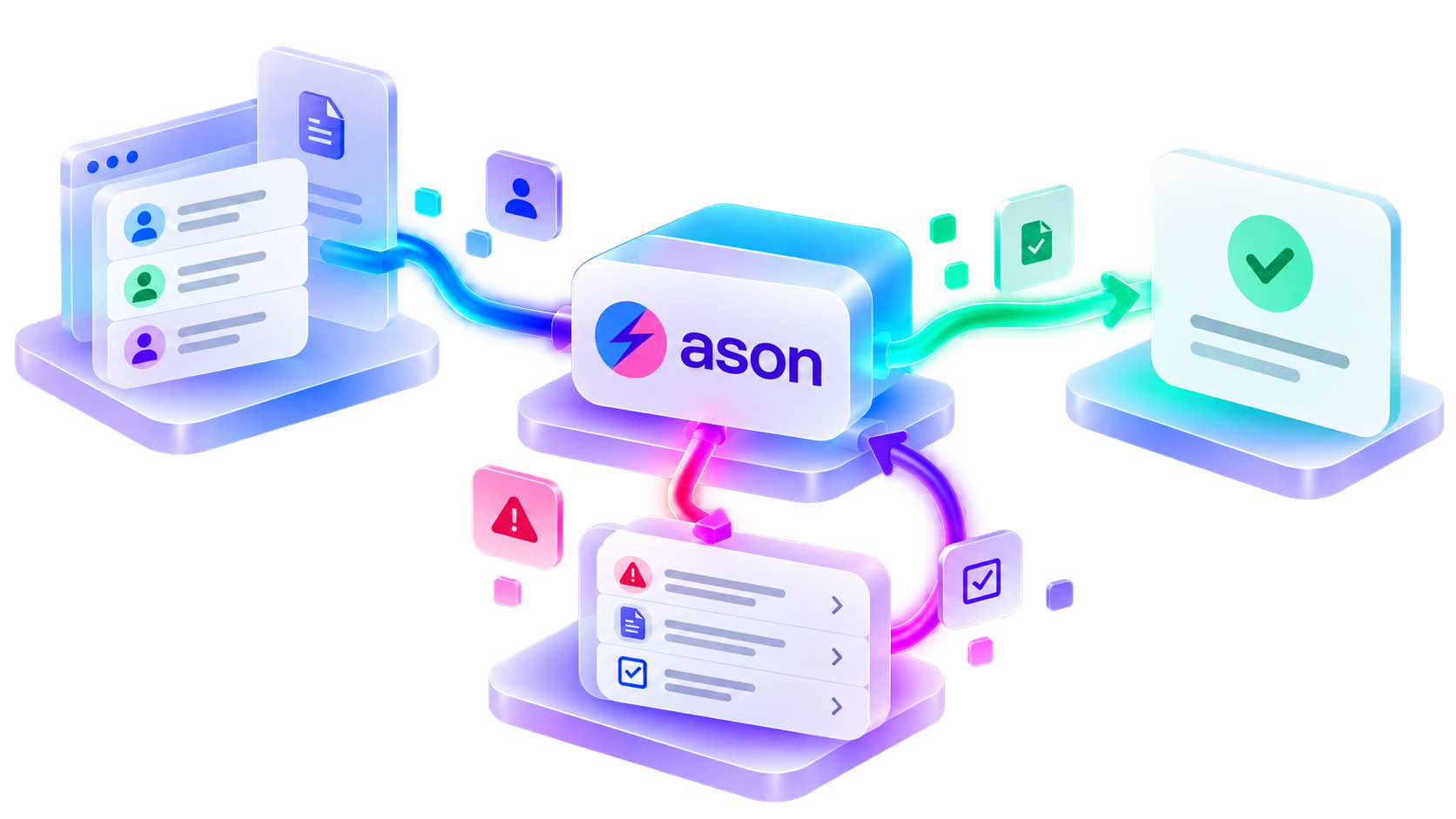
When platforms first integrate payroll, one assumption comes up again and again:
We already have the employee data. Why do we need another process?
Because payroll is not simply a calculation based on a predefined set of fields.
Payroll is a rules engine.
And those rules determine which information is required, when it is required and which question needs to be answered next.
That is why we recommend that partners integrating Ason Payroll work with CaseMan.
Your data can look complete. Payroll can still disagree.
Imagine a new employee has been entered into your platform.
You already know the address, marital status, employment details and salary. From a traditional software perspective, the record may look complete.
Payroll may see something different.
A residence status can trigger additional withholding-tax requirements. That can require information about a spouse. The spouse information may then make further employment details relevant.
One answer creates the next question.
The important part is that not every question can be predicted when the employee is first created.
This is where traditional field mapping reaches its limits.
Payroll is a continuous validation loop
A conventional API integration often follows a simple logic:
Platform → Data → Calculation
Real payroll needs another layer.
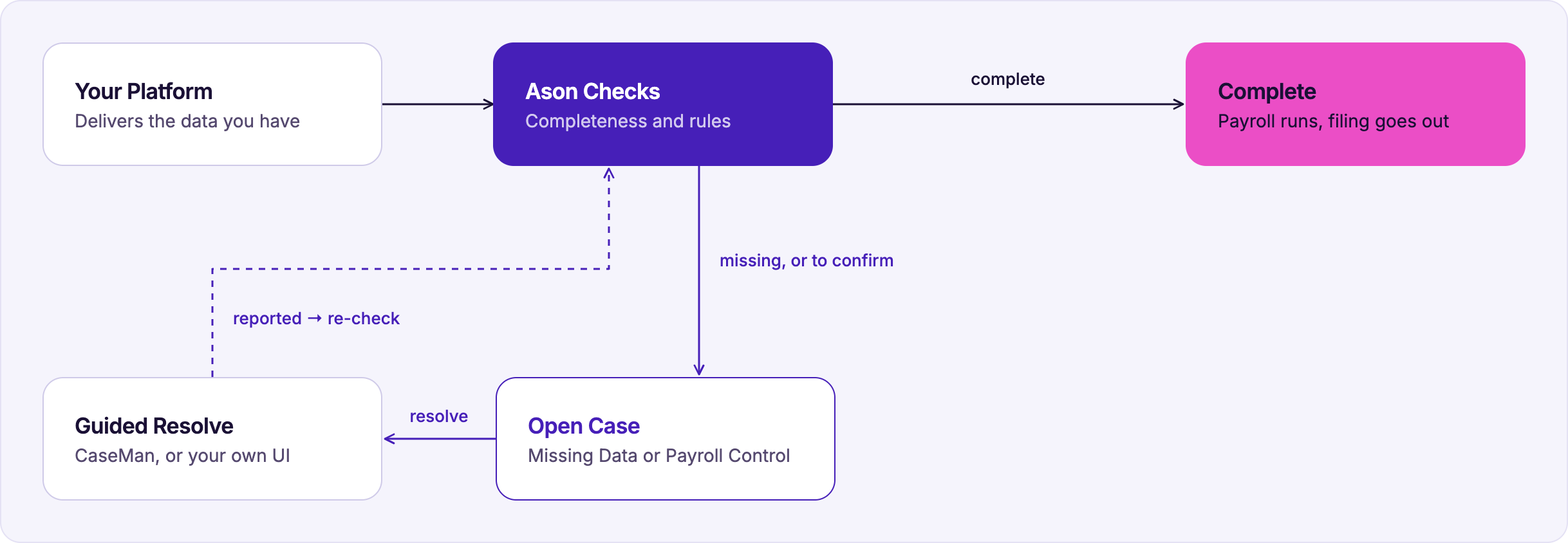
Ason continuously evaluates the available data against the applicable payroll and compliance rules.
If everything is complete, payroll can continue.
If something is missing, inconsistent or requires confirmation, Ason creates a case.
CaseMan guides the user through resolving it. Once new information is provided, Ason checks the situation again.
If that information creates another requirement, the next case appears.
This dynamic loop is fundamental to real-time payroll.
Why we recommend CaseMan
Partners can build their own frontend on top of the Ason APIs. But for most integrations, we recommend starting with CaseMan.
The reason is architectural.
Your platform owns the data. Ason owns the payroll rules. CaseMan connects the two.
Your product continues to manage employee data, contracts, working time and the workflows that are core to your platform.
Ason determines whether that information is sufficient for compliant payroll processing and what additional information or confirmation is required.
CaseMan turns these requirements into actionable workflows.
Your development team therefore does not need to reproduce Swiss payroll logic in the frontend.
This becomes even more important at scale
For one employee, an open payroll case may feel like a minor inconvenience.
Across hundreds or thousands of employees, it becomes an operational risk.
A single employee can generate several cases. Some occur only once. Others can return every payroll period, for example because hours or payroll-specific controls have to be provided again.
The challenge is therefore not simply transferring more data.
It is knowing which data is still required for which employee at which moment.
CaseMan makes this explicit instead of hiding it in error messages, manual checklists or support processes.
Regulations can change without changing your product
This separation also matters over time.
Payroll requirements change. Swissdec requirements evolve. Legal rules and controls are updated.
If all this logic is built into your own product, regulatory changes become part of your development roadmap.
With Ason, the payroll logic remains within the payroll engine.
Your platform delivers structured data via API. Ason applies the current rules. CaseMan exposes what still needs to be resolved.
That means regulatory changes do not automatically require a new release on your side.
The shortest path to real-time payroll
Ason is designed for a continuous rather than batch-based payroll model.
Your platform can send data when it becomes available. Ason evaluates the new state immediately. If something is missing, a case appears. Once it is resolved, Ason re-checks the payroll.
The flow becomes:
Data changes → Ason checks → Case if required → User resolves → Ason re-checks
There is no need to wait for a separate data collection process at the end of the month.
That is what makes real-time payroll possible.
Can you build your own CaseMan experience?
Yes.
CaseMan is the recommended starting point, not a restriction.
Partners that want complete control over their user experience can later build their own frontend using the same underlying Ason calls.
The important principle remains:
Do not rebuild the payroll rules. Consume the cases generated by the payroll engine.
For many partners, the fastest path is therefore to integrate the Ason APIs, use CaseMan for the dynamic payroll workflows and bring selected flows into their own UI later if needed.
Payroll as a feature, not a compliance team you build
Embedded payroll should not require your company to become a payroll software vendor.
Your platform provides the data it knows.
Ason applies the payroll and compliance rules.
CaseMan handles what is still missing.
Once the cases are resolved, payroll continues.
That is why we recommend CaseMan for Ason integrations. It is the shortest path from employee data to compliant, real-time payroll.
Build payroll into your platform, without building payroll yourself.
Let’s scope your Ason integration.